> ## Documentation Index
> Fetch the complete documentation index at: https://docs.way.co/llms.txt
> Use this file to discover all available pages before exploring further.
# Introduction
> Build booking experiences on top of the Way platform
The Way API lets you build on top of the Way platform: list a brand's experiences on your own site or app, check live availability, run a complete checkout with payment, and manage the resulting bookings.
Way powers experiences for hotels, travel brands, and experience providers. With the API you can build custom booking interfaces, integrate Way inventory into your own ecosystem, or sync bookings and revenue data into internal systems - and webhooks keep your side up to date in real time.
## Listings, experiences, and resource groups
The vocabulary you'll see everywhere in this API:
* A **listing** is how an experience is presented on a brand's storefront - the title, photos, description, and price that guests browse and search. **When you want "all the experiences a brand offers" for display, fetch [Get all listings](/api-reference/listings/get-listings)** - that's the customer-facing catalog.
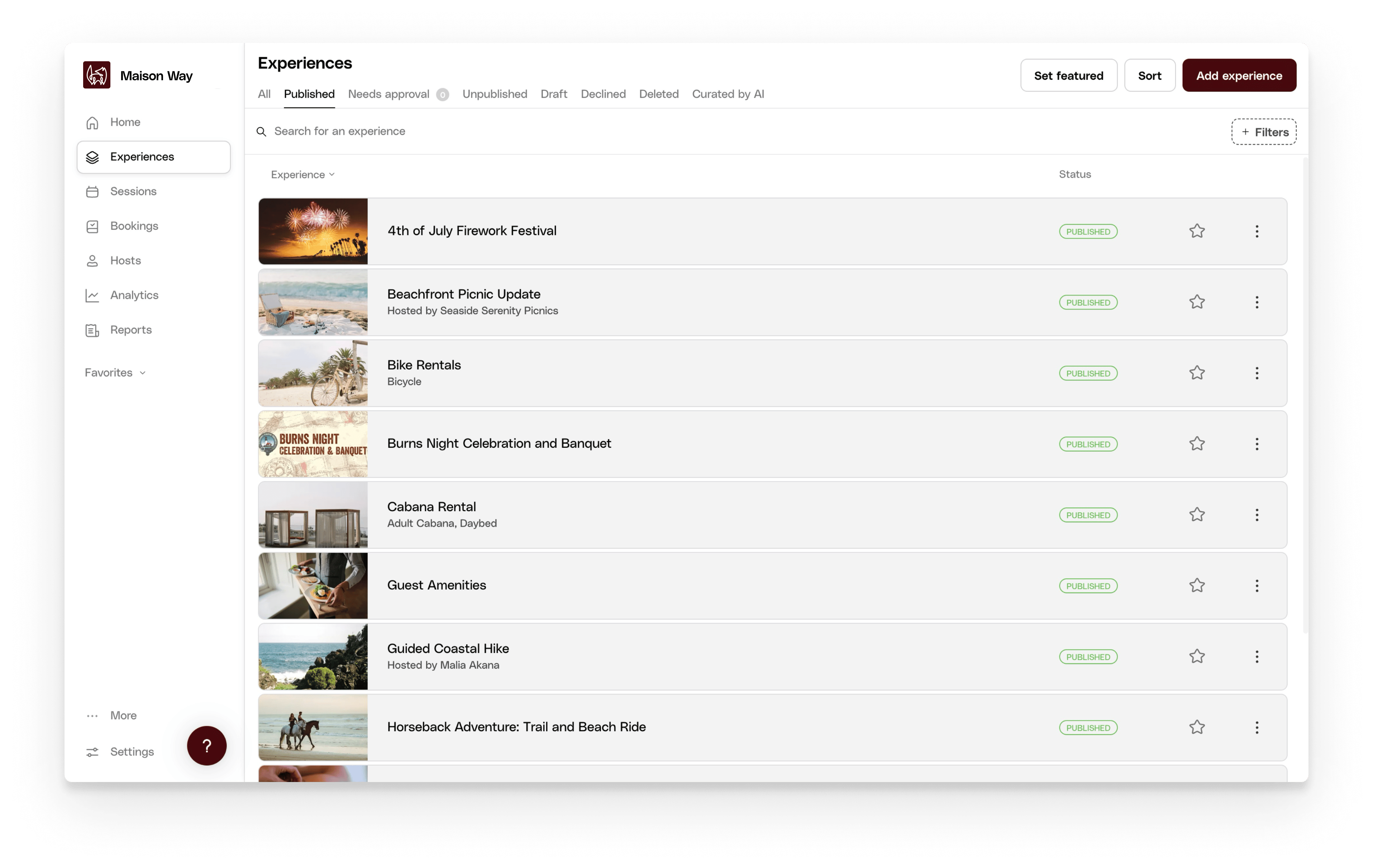
* An **experience** is the bookable item itself: its sessions, capacity, and price tiers. Every booking targets an experience - you'll use an `experienceId` when checking availability and creating bookings. There is also a [Get experiences](/api-reference/experiences/get-experiences) endpoint that returns these records directly - reach for it when you need scheduling configuration, not for building a storefront.
What sits between the two depends on the listing's `kind`:
```
Listing (kind: experience) → Experience
Listing (kind: resource) → Resource group collection → Resource groups → Experiences
```
* `experience` - a time-based activity (a tour, a class). The listing carries its `experienceId` directly.
* `resource` - the listing wraps a **resource group collection** (say, "Poolside Cabanas") made up of **resource groups** ("Cabana Row A"), whose bookable units are each backed by their own experience. That's why, for `resource` listings, the `experienceId` comes from the [session you select](/api-reference/listings/get-listing-sessions) rather than from the listing itself.
* `event` - a one-off happening with its own sub-flow.
 ## Where to start
Make your first authenticated API call in five minutes.
The end-to-end guide: list experiences, pick a session, take payment, and book.
Every endpoint, testable in the browser with your own API keys.
Get notified when bookings are created, cancelled, or rescheduled.
## Where to start
Make your first authenticated API call in five minutes.
The end-to-end guide: list experiences, pick a session, take payment, and book.
Every endpoint, testable in the browser with your own API keys.
Get notified when bookings are created, cancelled, or rescheduled.